AMD History: Complete Timeline of Advanced Micro Devices (1969–Present)
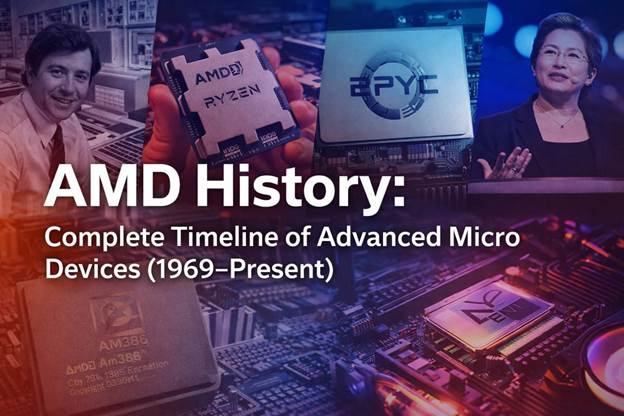
Advanced Micro Devices (AMD) has grown from a small semiconductor startup into a global leader in chip, CPU, and high-performance processors. Since its founding in 1969, AMD has consistently pushed the boundaries of computing technology. Its innovations power systems running Windows, Linux, and MacOS, while also supporting enterprise environments for companies like Microsoft, Google, Oracle, and IBM.
The company’s influence spans consumer devices, servers, gaming systems, and modern cloud computing infrastructures. AMD also plays a critical role in artificial Intelligence, enabling complex machine learning workloads and advanced data processing. Its long-standing rivalry with Intel has driven rapid innovation in CPU performance, efficiency, and pricing.
Foundation of AMD (1969–1975)
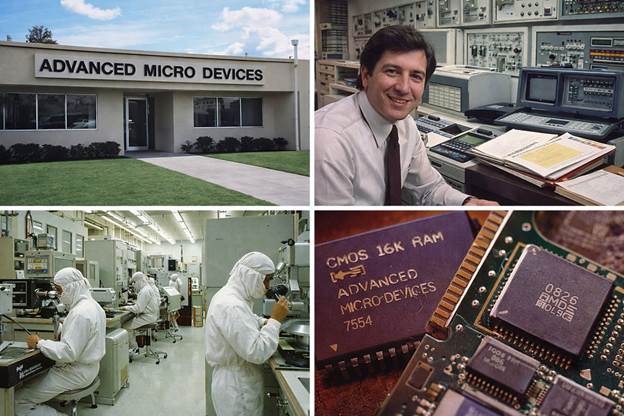
AMD was officially founded on May 1, 1969, by Jerry Sanders and a group of talented engineers from Fairchild Semiconductor. The company was established in Sunnyvale, California, which later became the heart of Silicon Valley. From the beginning, AMD focused on producing high-quality semiconductor chips and memory components.
During its early years, AMD specialized in logic circuits and ram, supplying parts to major technology firms. The company quickly built a reputation for reliability, which helped secure partnerships with organizations like IBM and HP. These partnerships allowed AMD to grow its manufacturing capabilities and expand its influence in the semiconductor industry.
AMD’s early strategy also included becoming a second-source manufacturer for companies like Intel. This meant AMD produced compatible versions of existing chips, ensuring supply chain stability for customers. This approach provided AMD with valuable experience in CPU design and semiconductor fabrication.
The leadership of Jerry Sanders played a crucial role in shaping AMD’s identity. He emphasized innovation, quality, and customer trust. His famous philosophy, “Real men have fabs," reflected the company’s commitment to in-house manufacturing.
By the mid-1970s, AMD had established itself as a credible semiconductor company. It had developed strong engineering teams, reliable production processes, and a growing list of clients. This period laid the foundation for AMD’s future expansion into microprocessors and advanced computing systems.
Entering the CPU Market (1975–1990)
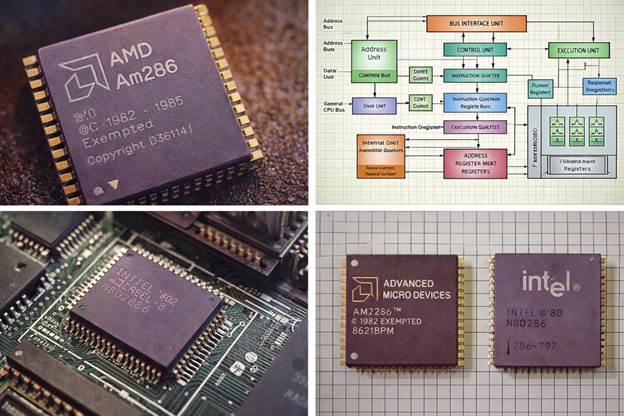
Between 1975 and 1990, AMD transitioned from a component manufacturer into a serious participant in the CPU market. This shift was largely driven by agreements with Intel that allowed AMD to produce x86-compatible processors.
In 1982, AMD signed a technology exchange agreement with Intel, enabling it to manufacture processors like the Am286. These CPUs were used in early personal computers, many of which ran operating systems such as Windows and enterprise solutions from IBM.
The 1980s also saw rapid growth in the personal computer industry. As demand for computing increased, AMD’s role became more significant. Its processors were used in systems built by HP and other major hardware companies.
However, tensions between AMD and Intel began to rise. By 1987, legal disputes emerged regarding licensing agreements and intellectual property. These conflicts would shape the competitive landscape of the CPU industry for decades.
During this period, AMD gained deep expertise in processor architecture, manufacturing processes, and system integration. It also contributed to the expansion of programming ecosystems, supporting developers working on software for Windows and early Linux systems.
By the end of the 1980s, AMD had evolved from a supporting manufacturer into a company capable of designing its own processors. This transformation marked the beginning of its independence and long-term competition with Intel.
Independence and Innovation (1990–1999)
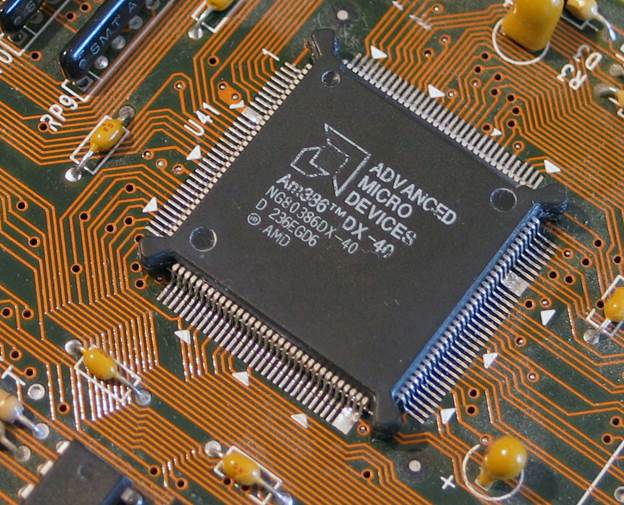
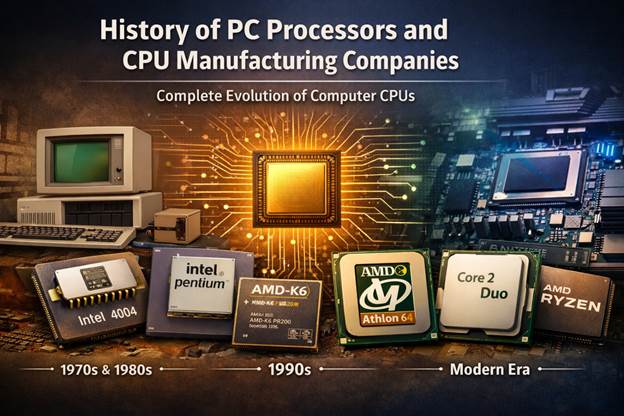
The 1990s were a defining decade for AMD. In 1991, AMD released the Am386 processor, marking its entry into independent CPU design. This product was significant because it demonstrated AMD’s ability to compete directly with Intel.
Throughout the decade, AMD introduced several important processors, including the Am486 and the K5. However, it was the acquisition of NexGen in 1996 that accelerated AMD’s innovation. This acquisition brought in new talent and technology, including contributions from engineers like Dirk Meyer.
In 1997, AMD launched the K6 processor, which quickly became popular due to its strong performance and affordability. These processors were widely used in systems running Windows and Linux, making computing more accessible to a broader audience.
The growth of the internet during this period also increased demand for powerful CPUs. Companies like Microsoft and Google were expanding their software ecosystems, while Oracle was developing enterprise database systems.
AMD’s processors supported these advancements, enabling faster computing, better multitasking, and improved user experiences. The company also continued to refine its manufacturing processes, ensuring higher efficiency and reliability.
By the end of the 1990s, AMD had firmly established itself as a major competitor in the CPU market. Its ability to innovate and adapt positioned it for even greater success in the next decade.
The Athlon Revolution (1999–2005)
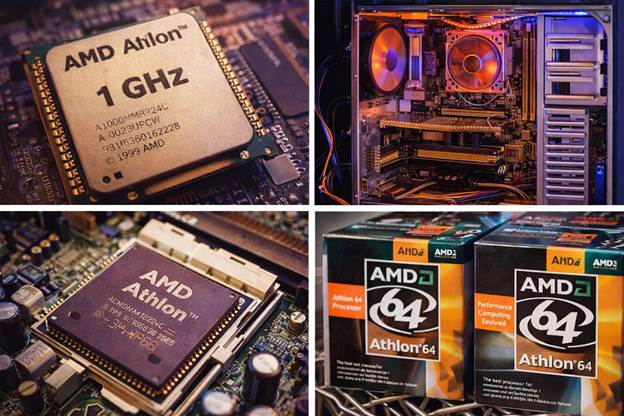
The launch of the Athlon processor in 1999 marked a turning point in AMD’s history. For the first time, AMD not only competed with Intel but surpassed it in performance benchmarks.
In 2000, AMD achieved a major milestone by releasing the first CPU to reach 1 GHz. This accomplishment demonstrated AMD’s engineering capabilities and solidified its reputation as an innovator.
Under CEO Hector Ruiz, AMD continued to push boundaries. In 2003, the company introduced the Opteron processor, which brought 64-bit computing to mainstream servers and desktops. This innovation allowed systems to handle larger amounts of RAM and process more complex workloads.
The Athlon 64 processor further expanded AMD’s influence in consumer markets. These processors were widely used in gaming PCs, workstations, and enterprise systems.
AMD’s success during this period was driven by its focus on performance, efficiency, and affordability. It also benefited from the growing demand for computing power, driven by digital content, programming, and internet applications.
This era established AMD as a true leader in the semiconductor industry and set the stage for future innovations in cloud computing and artificial intelligence.
Expansion into Servers and Cloud (2005–2010)

Between 2005 and 2010, AMD expanded its focus to enterprise computing and cloud infrastructure. The Opteron processor became a key component in data centers and server environments.
Major companies like IBM, HP, and Oracle adopted AMD processors for their systems. These CPUs provided strong performance, scalability, and energy efficiency, making them ideal for enterprise workloads.
During this period, the concept of cloud computing began to gain traction. AMD processors played a crucial role in enabling virtualization, allowing multiple applications to run on a single server.
This technology supported the growth of services provided by companies like Microsoft and Google. It also enabled secure systems for managing passwords, databases, and large-scale applications.
AMD’s contributions to server technology helped shape the modern internet. Its processors powered early cloud platforms, supporting everything from web hosting to enterprise software solutions.
By the end of this era, AMD had established itself as a key player in both consumer and enterprise markets.
Challenges and Transition (2010–2016)
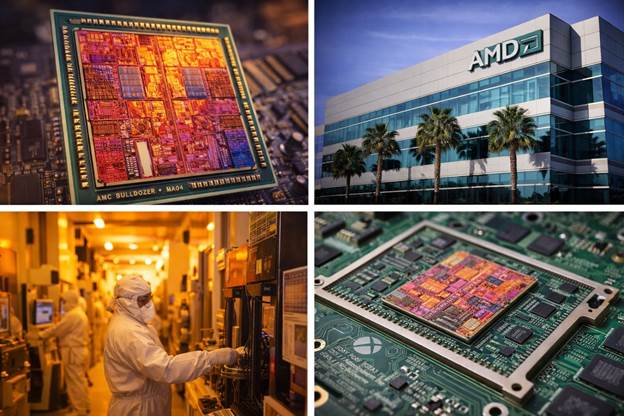
The period from 2010 to 2016 was one of the most challenging in AMD’s history. The Bulldozer architecture, introduced in 2011, failed to meet performance expectations.
Under CEO Rory Read, AMD underwent significant restructuring. The company shifted its focus toward GPUs and semi-custom chips, particularly for gaming consoles developed by Sony and Microsoft.
Despite its struggles in the CPU market, AMD maintained a strong presence in other areas. Its chips powered gaming systems and supported platforms like Android and cloud-based services.
AMD also continued investing in future technologies, including artificial intelligence and advanced computing architectures. These investments would later play a key role in its recovery.
This period taught AMD valuable lessons about innovation, market positioning, and long-term strategy.
The Zen Revolution and Ryzen Era (2017–Present)
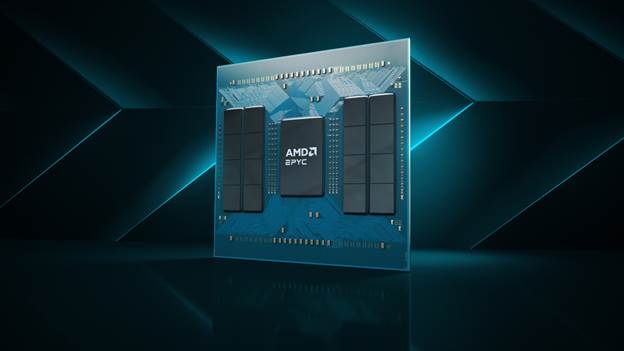
AMD’s comeback began with the introduction of the Zen architecture in 2017. Under the leadership of CEO Lisa Su, the company launched Ryzen processors, which delivered significant improvements in performance and efficiency.
Engineers like Jim Keller played a crucial role in designing Zen. These processors quickly gained popularity among gamers, developers, and professionals.
AMD also introduced EPYC processors for servers, which became widely used in cloud computing environments. These CPUs powered data centers used by companies like Microsoft, Google, and Oracle.
The Ryzen lineup continued to evolve with new generations, including 7nm and 5nm architectures. These advancements improved performance, reduced power consumption, and enhanced scalability.
AMD’s processors are now widely used for programming, artificial intelligence, and high-performance computing. They support modern applications, including machine learning, data analytics, and cloud services.
This era represents AMD’s strongest position in decades, with the company competing directly with Intel across all major markets.
AMD in Artificial Intelligence and Future Technologies
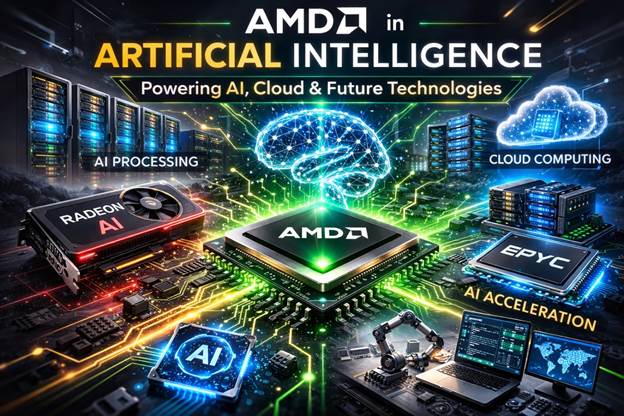
AMD is increasingly focused on artificial intelligence and future computing technologies. Its processors and accelerators are designed to handle complex AI workloads, including machine learning and deep learning.
The company is also investing in cloud computing, edge computing, and advanced semiconductor manufacturing. These technologies are essential for modern applications, from autonomous systems to large-scale data analysis.
AMD’s partnerships with major technology companies ensure its continued relevance in the industry. Its processors power everything from smartphones to enterprise servers.
Looking ahead, AMD is expected to play a major role in shaping the future of computing. Its innovations will continue to drive advancements in performance, efficiency, and scalability.
AMD vs Intel: Long-Term Rivalry and Market Impact
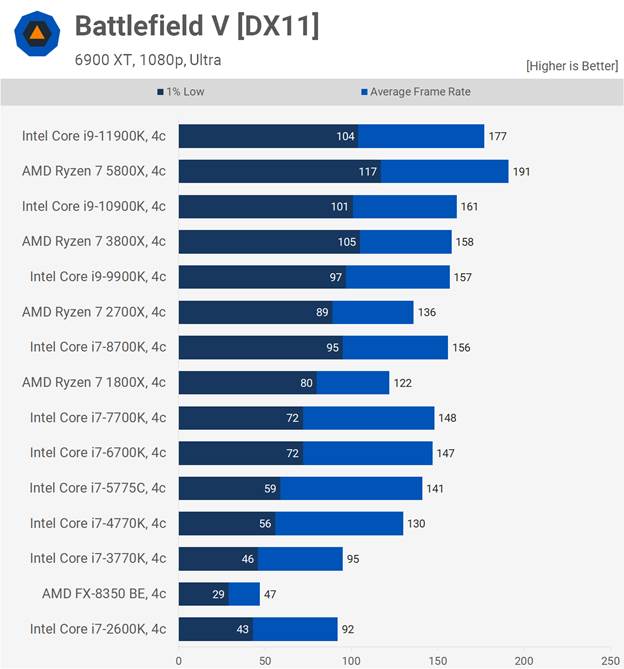
The competition between AMD and Intel has been one of the most important rivalries in technology history. This rivalry has driven innovation, reduced prices, and improved performance for consumers.
AMD’s focus on multi-core performance and value has made it a strong competitor in recent years. Meanwhile, Intel continues to innovate in areas such as single-core performance and manufacturing processes.
This competition benefits the entire industry, encouraging continuous improvement and technological advancement.
Conclusion
AMD’s journey from its founding in 1969 by Jerry Sanders to its current leadership under Lisa Su is a story of innovation, resilience, and transformation. From early semiconductor chips to advanced processors used in artificial intelligence and cloud computing, AMD has consistently shaped the future of technology.
Today, AMD stands as a global leader, powering systems across industries and continuing to push the boundaries of what is possible in computing.