WhatsApp History and Evolution: From Startup Idea to Global Messaging Leader

Introduction to WhatsApp
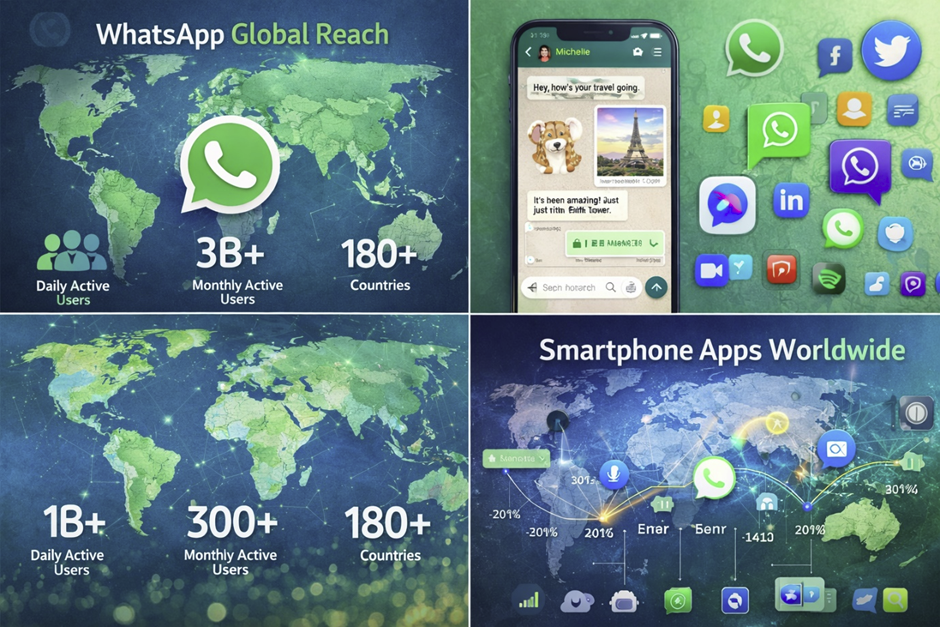
WhatsApp is a globally recognized messaging platform that allows users to send text messages, voice notes, images, videos, and documents instantly through the internet. It was officially launched on May 3, 2009, in Mountain View, California, and has since become a cornerstone of modern communication. Unlike traditional systems that relied on SMS or file transfers through USB drives and even older technologies like floppy disks, WhatsApp introduced a faster and more efficient approach. The rapid growth of smartphones from companies such as Samsung, Sony, and Motorola made it possible for such an app to thrive. With improvements in mobile hardware like processors and increased ram, real-time communication became seamless. Today, WhatsApp has surpassed 3 billion users worldwide, making it the most widely used messaging application. It plays a central role in both personal and professional communication, replacing many traditional methods. Its simplicity and reliability have allowed it to dominate even over platforms built on systems like Windows by Microsoft.
Founders and Early Vision

WhatsApp was founded by Jan Koum and Brian Acton, two experienced engineers who previously worked at Yahoo. Their background in large-scale systems and backend development played a crucial role in shaping the app’s architecture. Both founders shared a strong belief in simplicity and user privacy, which set WhatsApp apart from competitors. At a time when companies like Google and Microsoft were expanding their data-driven ecosystems, WhatsApp chose a minimalistic approach. Their experience in enterprise-level environments similar to systems developed by IBM and Oracle helped them build a scalable platform. The founders focused on creating a messaging app that required no complex setup or technical knowledge. This approach made it accessible to users worldwide. Their vision laid the foundation for one of the most successful applications in history.
Background of Jan Koum
Jan Koum, born in Kyiv, Ukraine, moved to the United States as a teenager and developed a deep interest in computers and networking. Growing up in a modest environment, he learned to value efficiency and simplicity. He later joined Yahoo, where he worked on infrastructure and messaging systems for several years. His experience in handling large-scale systems gave him insight into how communication platforms should operate. Koum was also strongly focused on privacy, which later influenced WhatsApp’s encryption system. His familiarity with environments like Linux helped him understand scalable backend systems. He believed that communication should remain private and secure. This belief became one of WhatsApp’s core principles. His journey from humble beginnings to a global tech leader is widely recognized.
Background of Brian Acton
Brian Acton was an experienced software engineer with a strong background in backend systems and infrastructure. Before co-founding WhatsApp, he worked at Yahoo, where he developed large-scale applications. His expertise in distributed systems and efficient programming complemented Koum’s skills. After leaving Yahoo in 2007, Acton invested his own savings into WhatsApp, showing strong commitment to the project. He believed in creating products that prioritize users rather than profits. His engineering approach focused on stability and scalability. This helped WhatsApp handle rapid user growth without major issues. His role was essential in transforming the app into a reliable global platform.
Vision Behind WhatsApp
The vision behind WhatsApp was to create a simple, fast, and secure communication tool. Unlike many platforms influenced by advertising models, WhatsApp avoided ads completely. The founders wanted users to focus only on communication without distractions. Privacy was a key priority, leading to the later adoption of encryption technologies. Their approach aligned with modern trends in secure web development and lightweight applications. They aimed to build a platform that could work efficiently even on devices with limited resources. This simplicity allowed WhatsApp to expand rapidly across different regions. Their philosophy proved that a clean and focused product can outperform complex systems.
The Creation of WhatsApp (2009)

WhatsApp was officially created in 2009 in California, but its initial concept was very different from what it is today. The app started as a simple status-sharing platform, allowing users to display short updates. However, it faced multiple challenges, including frequent crashes and low user engagement. At one point, Jan Koum considered abandoning the project entirely. The breakthrough came when Apple introduced push notifications, which enabled real-time communication. This feature transformed WhatsApp into a messaging platform almost instantly. Users began replying to status updates, creating conversations. This unexpected shift marked the beginning of WhatsApp’s success.
Original Idea
The original idea behind WhatsApp was to create a status-sharing application. Users could update their availability, such as being busy or at work. While this concept was innovative, it lacked strong engagement features. The app struggled to retain users due to limited functionality. However, it introduced the foundation for real-time communication. This idea later evolved into a full messaging system. The early struggles played a key role in shaping the final product.
Role of Push Notifications
Push notifications introduced in 2009 were a major turning point for WhatsApp. This feature allowed the app to send real-time alerts to users. WhatsApp used this to notify users about status updates. Soon, users began responding, turning the app into a messaging platform. This transformation was driven by user behavior rather than planned design. It demonstrated the importance of adapting to new technologies. Push notifications remain a core feature in modern apps.
First Version and Launch
The first version of WhatsApp was launched on the Apple App Store in 2009. It was simple, minimalistic, and focused on core functionality. Despite initial issues, it gradually gained users. Updates improved stability and added new features. The messaging feature significantly boosted its popularity. The app quickly expanded beyond its initial user base. This marked the beginning of its global journey.
Early Growth and Expansion (2010–2013)
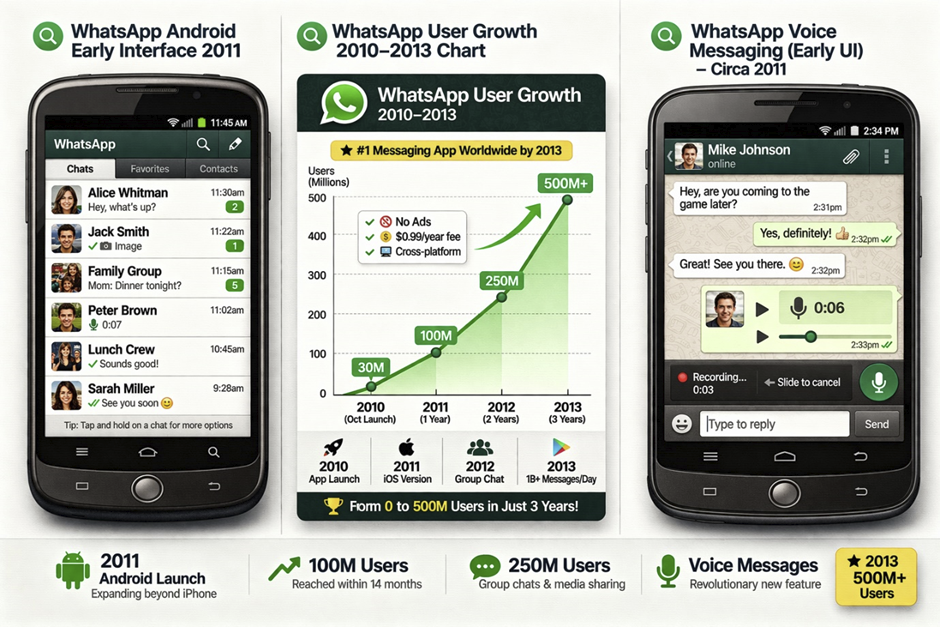
Between 2010 and 2013, WhatsApp experienced rapid growth driven by the global expansion of smartphones. The launch on Android significantly increased accessibility and user adoption. Android devices became widely available, especially in developing regions. This allowed WhatsApp to reach a much larger audience. Unlike complex systems requiring system administration, WhatsApp remained simple and user-friendly. The app was optimized to run on devices with limited ram and lower-end hardware. This inclusivity played a major role in its success. By 2013, WhatsApp had reached over 200 million users worldwide.
Launch on Android
The release of WhatsApp on Android in 2010 was a major milestone. It allowed the app to expand beyond iPhone users. Android’s flexibility made it easier to distribute globally. This helped WhatsApp grow rapidly in emerging markets. The platform became accessible to millions of users. This expansion was critical for its global success.
User Growth Milestones
WhatsApp’s growth was rapid and consistent during this period. It quickly became one of the most downloaded apps. By 2013, it had reached over 200 million users. This growth was driven by simplicity and reliability. Users preferred it over traditional messaging services. The app continued to expand globally.
Features Introduced
During this period, WhatsApp introduced key features such as messaging, media sharing, and group chats. Users could send images, videos, and documents like PDF files. Voice messaging was also introduced in 2013. These features replaced older communication methods. The app became a complete messaging platform.
Facebook Acquisition and Its Impact (2014)

In February 2014, WhatsApp was acquired by Facebook (now Meta Platforms) for an impressive $19 billion, making it one of the largest technology acquisitions in history. At the time, WhatsApp already had hundreds of millions of users and was growing faster than most other messaging platforms. This acquisition allowed Facebook to strengthen its position in global communication and compete with other emerging apps. Despite initial concerns about privacy and data usage, WhatsApp continued to operate independently with its core philosophy intact. The deal also provided access to better infrastructure, enabling faster performance and scalability. With support from a global company, WhatsApp expanded its services and improved reliability across regions. This move helped it dominate markets where traditional SMS services were still widely used. The acquisition marked a turning point in WhatsApp’s evolution into a global communication giant.
$19 Billion Deal Explained
The $19 billion acquisition of WhatsApp by Facebook in 2014 was a strategic move aimed at securing dominance in mobile messaging. Facebook recognized that WhatsApp had a rapidly growing user base and strong engagement levels. The deal included cash, stock, and additional incentives for founders Jan Koum and Brian Acton. At the time, it was the largest acquisition of a venture-backed company. Facebook wanted to ensure it stayed ahead in the messaging space, especially with increasing competition. WhatsApp’s simplicity and global reach made it an attractive investment. The acquisition also allowed Facebook to integrate messaging ecosystems more effectively. This decision shaped the future of digital communication.
Global Expansion After Acquisition
After the acquisition, WhatsApp experienced accelerated growth across multiple regions. With Facebook’s resources, the app improved its infrastructure and performance. It expanded rapidly in markets such as India, Europe, and Latin America. The platform became the primary communication tool for millions of users. Its lightweight design allowed it to run efficiently even on lower-end devices. This helped it dominate regions with limited internet speed and device capabilities. The global expansion reinforced WhatsApp’s position as the leading messaging platform. It became a standard communication tool worldwide.
Removal of Subscription Fee
Initially, WhatsApp charged users a small annual fee after a free trial period. However, in 2016, this subscription model was completely removed. This decision made the app entirely free to use for everyone. Removing the fee significantly increased user adoption, especially in developing countries. It also aligned with the company’s vision of accessible communication. The free model allowed WhatsApp to grow even faster. It eliminated barriers for new users. This change played a key role in reaching billions of users globally.