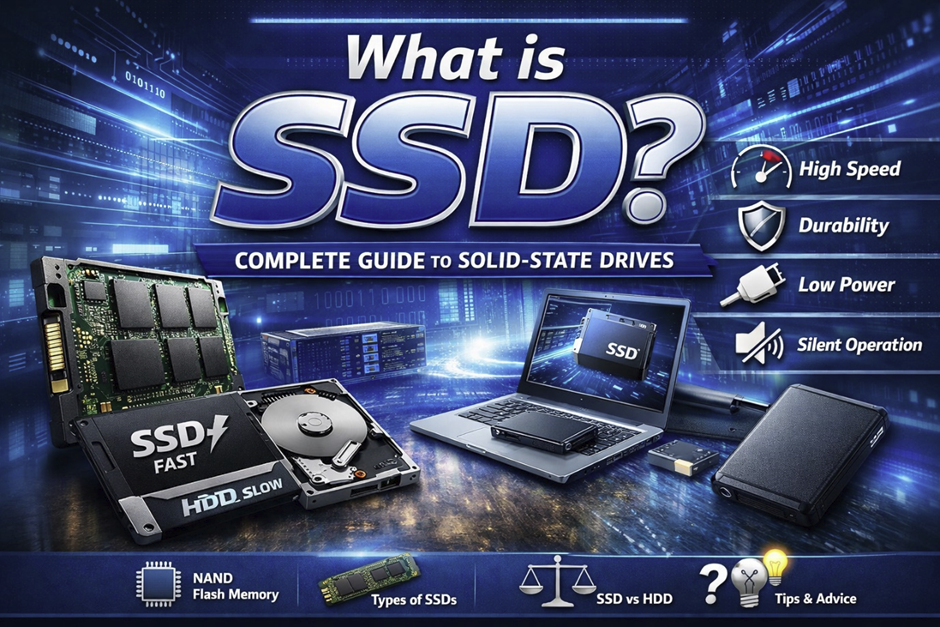
History of PC Processors and CPU Manufacturing Companies: Complete Evolution of Computer CPUs
Personal computer processors have played a crucial role in the development of modern computing. From the first microprocessors introduced in the early 1970s to today’s powerful multi-core chips capable of running artificial Intelligence, processors have continuously evolved to deliver higher performance, better efficiency, and new capabilities.
Every computer running Windows, Linux, MacOS, or Android relies on a central processing unit to execute software instructions, manage memory, and control system operations. Companies such as Intel, AMD, IBM, and HP have contributed significantly to processor innovation, while software ecosystems created by Microsoft, Google, and Oracle have pushed the limits of CPU performance.
In this comprehensive guide, we explore the history of PC processors, the companies that developed them, and the technological innovations that shaped modern computing.
Introduction to PC Processors
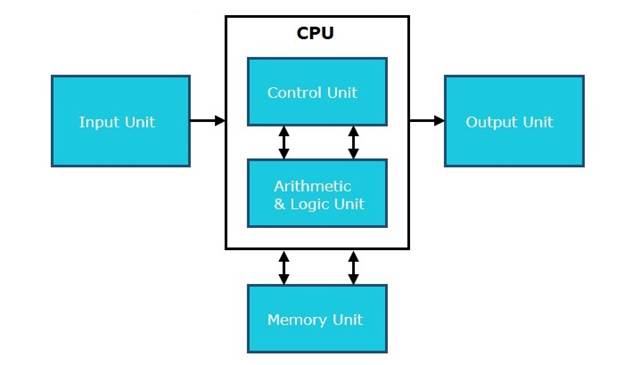
What Is a CPU (Central Processing Unit)
A central processing unit (CPU) is the primary component responsible for executing instructions in a computer system. It performs calculations, processes data, and manages communication between different hardware components. The processor reads instructions from software, interprets them, and performs operations required by applications and the operating system.
Every time a user launches a program in Windows, opens files in MacOS, runs applications on Android, or executes commands in Linux, the CPU processes those instructions. Even simple tasks such as opening a PDF file, checking emails, or loading a website on Google involve thousands or millions of processor operations.
Processors also coordinate communication between important system components such as ram, storage drives, and graphics hardware. Without this coordination, modern computers would not be able to function properly.
Why Processors Are the Heart of a Computer
The processor is often called the brain of a computer because it controls how instructions are executed. It determines how fast programs run and how efficiently a system performs tasks.
For example, when users perform tasks such as programming, video editing, or data analysis, the CPU continuously executes complex mathematical calculations. These tasks rely heavily on processor performance.
Modern processors are capable of executing billions of instructions per second, making them essential for advanced computing tasks including artificial Intelligence, gaming, and enterprise cloud infrastructure.
How CPU Technology Changed Personal Computing
Advances in CPU technology have dramatically transformed personal computing. Early computers were extremely expensive and accessible only to large organizations. However, improvements in processor design allowed companies like IBM and HP to develop personal computers that were affordable for businesses and individuals.
As processors became more powerful, software companies such as Microsoft and Oracle created advanced operating systems and enterprise software platforms that required faster CPUs.
Today processors power everything from desktop computers and laptops to servers, mobile devices, and large-scale cloud computing systems.
The Birth of the Microprocessor (1970s)
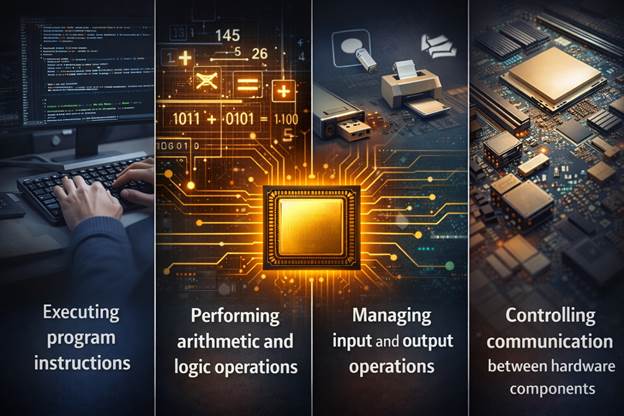
Development of the First Microprocessor
Before microprocessors existed, computers used multiple circuit boards containing hundreds or thousands of separate electronic components. These systems were expensive, large, and consumed significant power.
The invention of the microprocessor changed this completely. Engineers discovered that the entire central processing unit could be integrated into a single silicon chip. This breakthrough drastically reduced hardware complexity and allowed computers to become smaller and more affordable.
Intel 4004 – The First Commercial CPU
In 1971 Intel released the Intel 4004 microprocessor. This chip contained approximately 2,300 transistors and operated at a clock speed of around 740 kHz. Although modest by modern standards, it was a revolutionary technological achievement.
The Intel 4004 demonstrated that a complete CPU could be integrated into a single semiconductor chip. This concept laid the foundation for the modern computing industry.
Intel 8008 and Intel 8080
After the success of the 4004, Intel developed the 8008 and later the 8080 processors. These chips were more powerful and supported more advanced computing tasks.
The Intel 8080 became particularly popular among early computer enthusiasts and hobbyists. Many early computer kits used this processor, helping spark the personal computer revolution.
The Beginning of the x86 Architecture
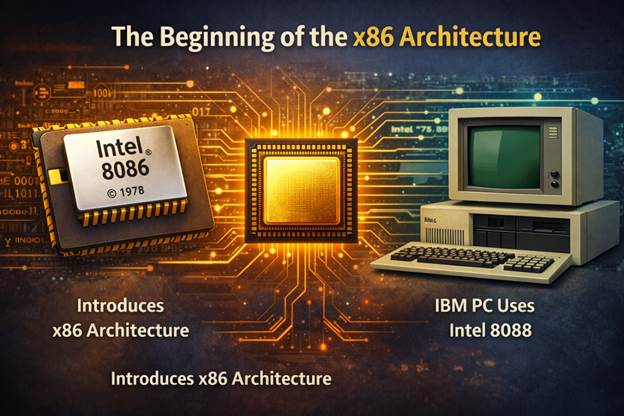
Intel 8086 and the Birth of x86
In 1978 Intel introduced the 8086 processor, which established the foundation of the x86 architecture. This processor used a 16-bit design that allowed computers to perform more complex instructions and memory operations.
The x86 architecture became extremely influential because it provided compatibility between different generations of processors. Software written for earlier processors could still run on newer systems.
Intel 8088 and the First IBM PC
In 1981 IBM released the first IBM PC using the Intel 8088 processor. Although similar to the 8086, the 8088 used an 8-bit external data bus that allowed cheaper system components.
The IBM PC quickly became a commercial success and established a standard architecture that other manufacturers followed.
Early Personal Computer CPU Development
The popularity of IBM-compatible computers created a strong ecosystem for x86 processors. Software developers began focusing their efforts on this architecture.
Companies such as Microsoft created operating systems optimized for x86 processors, including early versions of Windows. As a result, x86 processors became the dominant architecture in the personal computer market.
Early PC Processor Manufacturers
Intel – The Pioneer of PC Processors
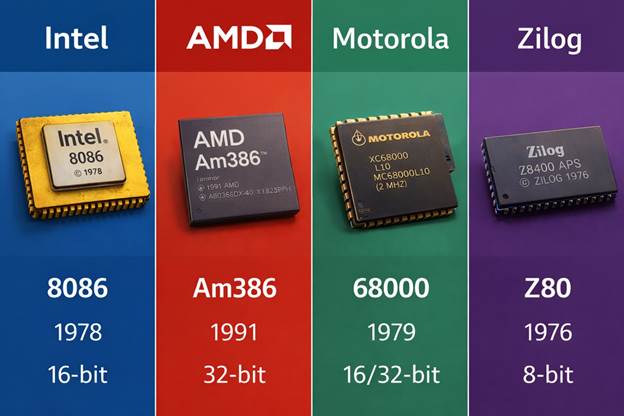
Intel played a critical role in the early development of personal computer processors. Its early chips established the architecture used in many personal computers.
Intel’s continued innovation helped maintain its leadership in the processor industry.
AMD – Intel’s First Major Competitor
Advanced Micro Devices (AMD) initially manufactured compatible versions of Intel processors under licensing agreements. Over time, AMD developed its own architectures and began competing directly with Intel.
Zilog – The Z80 Processor
The Zilog Z80 processor was widely used in early home computers and embedded systems. It became one of the most popular processors during the late 1970s and early 1980s.
Motorola – The 68000 Processor Family
Motorola’s 68000 processor family was used in several important computer systems. These processors influenced early workstation computers and later systems used in Apple devices.
The Evolution of Intel Processors
Intel 80286
The Intel 80286 processor introduced improved memory management features. It allowed computers to run more advanced operating systems and multitasking environments.
Intel 80386
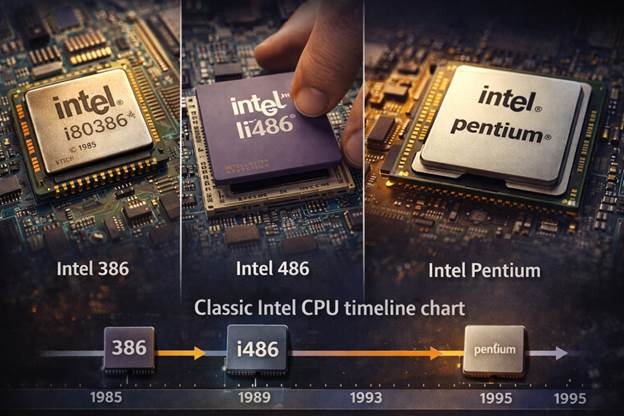
The 80386 processor introduced full 32-bit computing capabilities. This allowed computers to access much larger amounts of memory and run more complex applications.
Intel 80486
The Intel 80486 processor integrated floating-point calculations directly into the CPU, improving performance for engineering and scientific workloads.
Intel Pentium Series
The Pentium series became one of the most recognizable processor families in computing history. These processors powered millions of personal computers running Windows and Linux.
The Rise of AMD Processors
AMD Am386 and Am486
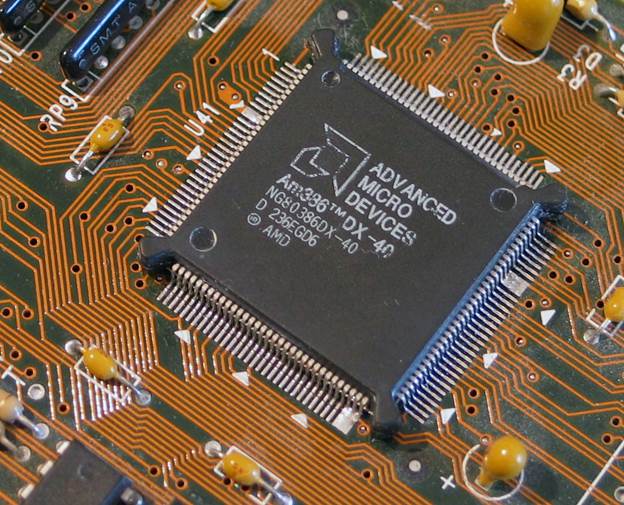
AMD produced processors compatible with Intel’s 386 and 486 CPUs. These chips allowed AMD to enter the mainstream personal computer processor market.
AMD K5 and K6 Processors
The K5 and K6 processors represented AMD’s first independent CPU architectures and provided strong competition to Intel processors.
AMD Athlon and Athlon XP
The Athlon processor family offered excellent performance and became popular among gamers and professionals.
AMD Athlon 64 and the Introduction of 64-bit Computing
The Athlon 64 introduced 64-bit computing for desktop systems, allowing computers to use larger amounts of ram and run more demanding applications.
The Multi-Core Processor Era
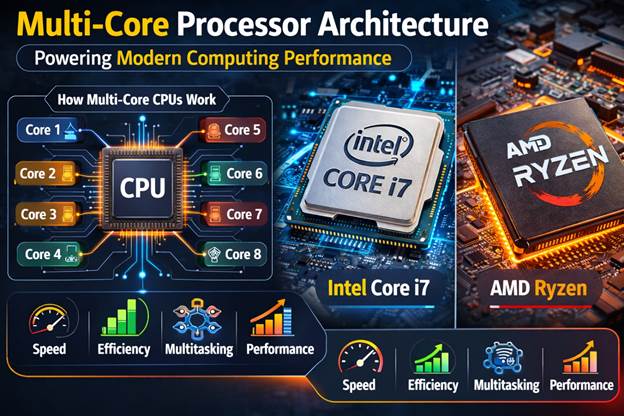
Intel Core Architecture
Intel introduced the Core architecture to improve performance and energy efficiency. These processors featured multiple cores capable of handling several tasks simultaneously.
AMD Phenom Processors
AMD Phenom processors introduced competitive multi-core designs that improved system performance for multitasking workloads.
Intel Core i3, i5, i7, and i9 Series
These processors became widely used in modern computers and support advanced workloads such as gaming, programming, and content creation.
AMD Ryzen Processor Family
AMD Ryzen processors revitalized competition in the CPU market and deliver strong performance for desktops and workstations.