Types of Programming Languages: Complete Guide to Categories, Features, and Uses
What Defines a Programming Language
A programming language is a structured system of communication used by developers to instruct computers to perform specific tasks. At its core, it acts as a bridge between human logic and machine execution. Every programming language follows a defined syntax and set of rules that determine how code is written and interpreted. These rules ensure consistency and reliability across different systems.
Programming languages vary significantly in complexity, readability, and purpose. Some are designed to interact closely with hardware, while others prioritize developer productivity and ease of use. The evolution of programming languages has been driven by the need for faster development cycles, improved performance, and scalable architectures.
Another important concept is abstraction. High abstraction allows developers to focus on solving real-world problems rather than dealing with hardware limitations. Low abstraction provides greater control but increases complexity.
Modern programming environments operate across platforms such as Linux, Windows, and MacOS, and are supported by major ecosystems from companies like Google, Microsoft, and IBM. This cross-platform capability makes software development more flexible and accessible.
Programming languages are also influenced by their communities, libraries, and frameworks. A strong ecosystem can significantly accelerate development and improve long-term support.
Key Features of Programming Languages
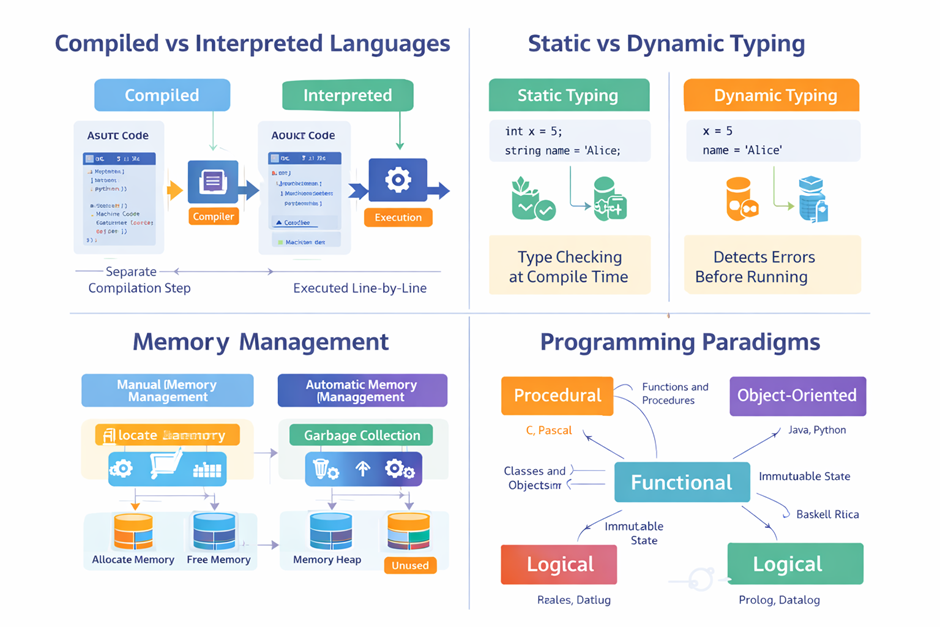
Understanding programming language categories requires analyzing their core features. These features define how a language behaves and where it is best applied.
One of the most important aspects is the level of abstraction. High-level languages simplify development, while low-level programming languages provide direct control over hardware such as the CPU, processors, and RAM.
Another key feature is execution type. Compiled languages convert code into machine instructions before execution, resulting in faster performance. Interpreted languages run code line-by-line, making them easier to debug and modify.
Typing systems also play a major role. Some languages use static typing for reliability, while others use dynamic typing for flexibility.
Programming paradigms define how code is structured. These include object-oriented programming, functional programming, and procedural approaches. Many modern languages support multiple paradigms.
Memory management is another critical factor. Some languages require manual control, while others automate memory handling using garbage collection.
These features collectively determine the strengths, limitations, and ideal use cases of different types of programming languages.
Types of Programming Languages
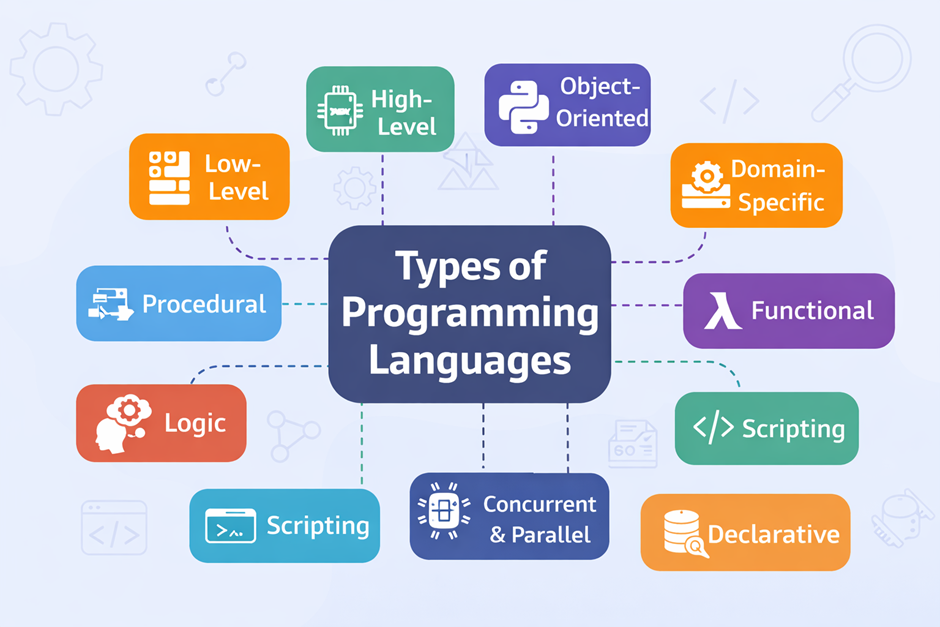
There are many types of programming languages, each designed for specific purposes. Understanding these programming language categories helps developers choose the right tools.
Low-Level Programming Languages
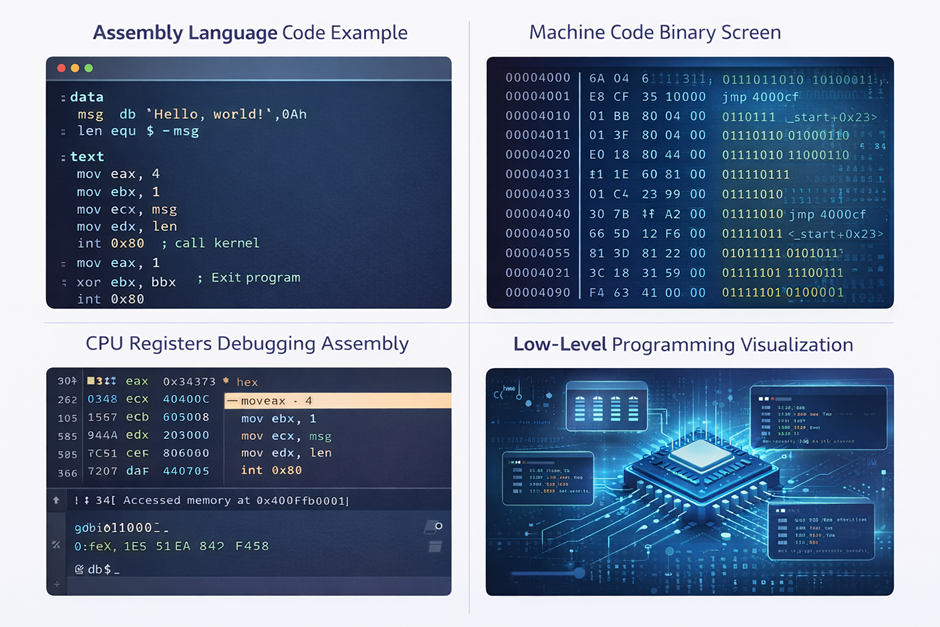
Low-level programming languages are the closest to computer hardware and provide minimal abstraction. These languages allow developers to interact directly with system components such as memory, registers, and processors. Because of this, they offer maximum control over system performance.
Machine language is the most basic form, consisting entirely of binary instructions that the computer can execute directly. Assembly language builds on this by using symbolic codes that are easier for humans to understand. Despite this improvement, it still requires a deep understanding of hardware architecture.
One of the biggest advantages of low-level languages is their speed. Since they operate very close to the hardware, programs written in these languages are highly efficient. This makes them ideal for operating systems, embedded systems, and firmware development.
These languages directly interact with hardware components like the CPU, processors, and memory units. In older systems, they were even used to manage storage devices such as floppy disks, while modern systems rely on USB drives and advanced interfaces.
However, low-level programming comes with significant challenges. The syntax is difficult to learn, and debugging can be complex. Even small mistakes can lead to critical system failures.
Another limitation is portability. Programs written for one hardware architecture often cannot run on another without modification.
Despite these drawbacks, low-level languages remain essential in areas where performance and precision are critical. They are widely used in embedded systems, device drivers, and real-time applications.
Examples of Low-Level Programming Languages:
- Assembly
- Machine Code
- ARM Assembly
- x86 Assembly
- MIPS
- RISC-V
- Embedded C
- Microcontroller Assembly
High-Level Programming Languages
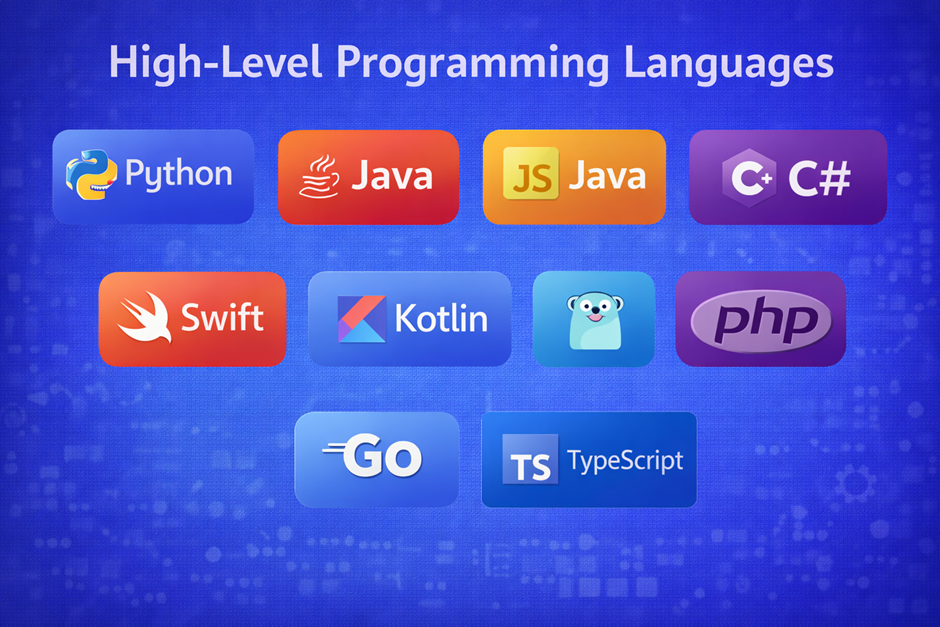
High-level programming languages are designed to be easy to read, write, and maintain. They abstract away the complexity of hardware, allowing developers to focus on solving problems rather than managing system resources.
These languages use human-readable syntax, making them accessible to beginners and professionals alike. Examples include Python, Java, and JavaScript.
One of the key advantages of high-level languages is productivity. Developers can write less code to achieve more functionality, reducing development time and effort.
They are widely used in web development, enterprise software, and system administration across platforms such as Android, Windows, and MacOS. Large ecosystems from companies like Google, Microsoft, and Oracle support these languages.
High-level languages are also highly portable. Many programs can run on different systems without modification, thanks to virtual machines and interpreters.
Another benefit is the availability of libraries and frameworks. These tools simplify tasks such as database management, networking, and user interface design.
However, abstraction can sometimes reduce performance compared to low-level languages. Despite this, modern optimization techniques often minimize the difference.
These languages dominate modern software development due to their flexibility and ease of use.
Examples of High-Level Programming Languages:
- Python
- Java
- JavaScript
- C#
- Ruby
- Swift
- Kotlin
- Go
- PHP
- TypeScript
Procedural Programming Languages
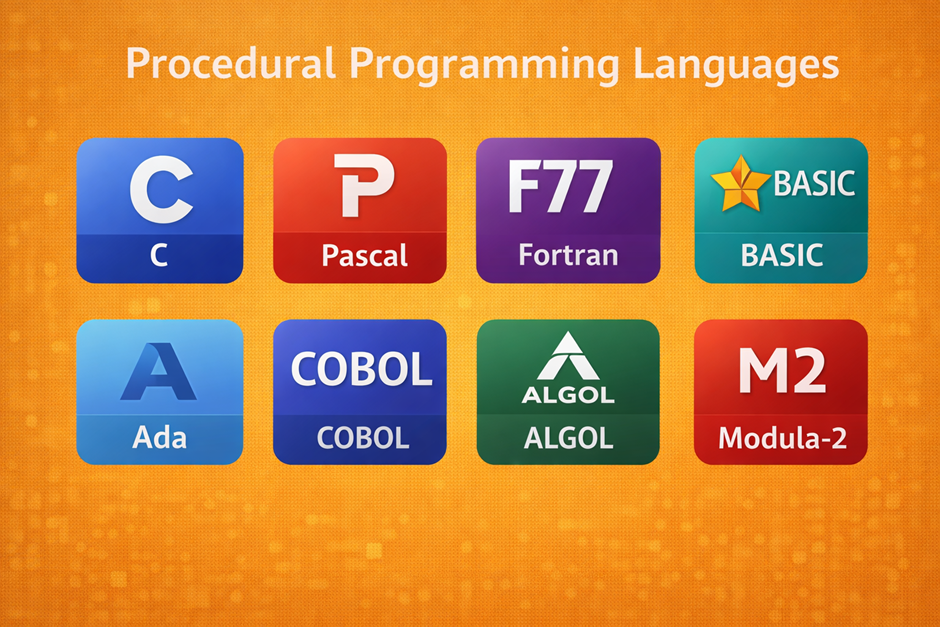
Procedural programming is one of the earliest and most fundamental programming paradigms. It is based on a step-by-step approach where instructions are executed in sequence.
Programs are divided into procedures or functions, each responsible for a specific task. This helps organize code and makes it easier to understand.
Languages like C and Pascal are classic examples of procedural programming. They emphasize control structures such as loops, conditionals, and function calls.
One of the main advantages is simplicity. The straightforward structure makes it easier for beginners to learn.
Procedural programming also encourages code reuse through functions. This reduces redundancy and improves maintainability.
However, as applications grow larger, managing complex systems can become difficult. The lack of abstraction compared to modern paradigms can lead to tightly coupled code.
Despite these limitations, procedural programming remains widely used. It forms the foundation for many modern languages.
It is especially useful in system programming, embedded systems, and performance-critical applications.
Examples of Procedural Programming Languages:
- C
- Pascal
- Fortran
- BASIC
- Ada
- COBOL
- ALGOL
- Modula-2
Object-Oriented Programming Languages
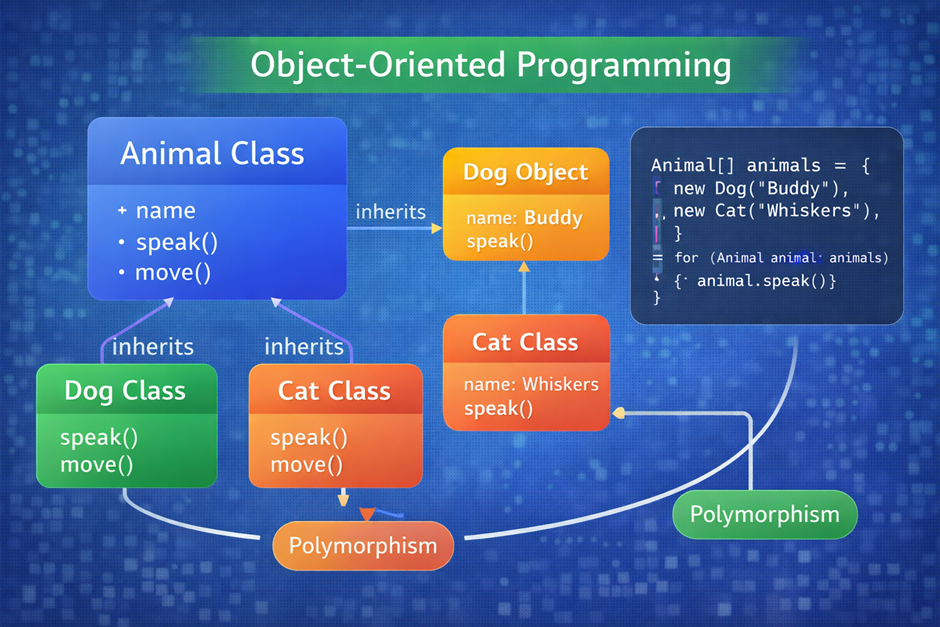
Object-oriented programming is one of the most widely used programming paradigms today. It organizes software design around objects, which represent real-world entities.
Each object contains both data and methods. This structure helps encapsulate functionality and improves modularity.
Key concepts include encapsulation, inheritance, polymorphism, and abstraction. These principles allow developers to build scalable and maintainable systems.
Languages like Java, C++, and Python support object-oriented design.
OOP is widely used in enterprise applications, mobile apps, and large-scale systems developed by companies such as Microsoft, IBM, and Google.
One major advantage is code reuse. Developers can extend existing classes instead of rewriting code.
It also improves maintainability by isolating different parts of a program.
However, OOP can introduce complexity if not used properly. Over-engineering can make systems harder to understand.
Despite this, it remains a dominant paradigm in modern software development.
Examples of Object-Oriented Programming Languages:
- Java
- C++
- Python
- C#
- Ruby
- Swift
- Kotlin
- Objective-C
- Dart
Functional Programming Languages
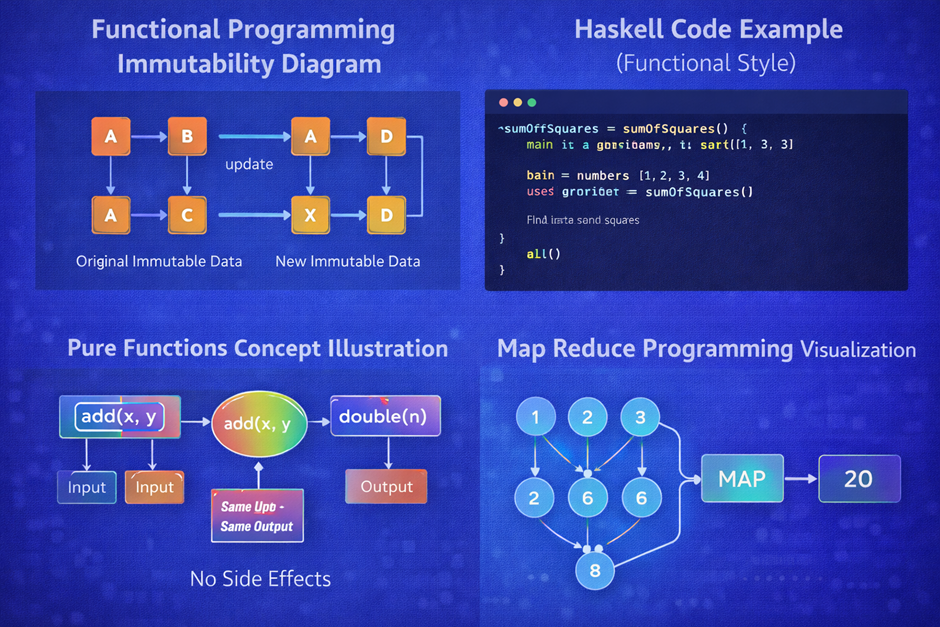
Functional programming is a paradigm that treats computation as the evaluation of functions. It avoids changing state and focuses on immutability.
Functions are treated as first-class citizens. This means they can be passed as arguments and returned as values.
Languages like Haskell and Lisp are known for their functional approach.
Functional programming is widely used in Artificial Intelligence, data processing, and distributed systems.
One of its biggest advantages is predictability. Since there are no side effects, programs are easier to test and debug.
It also supports parallel processing, making it suitable for high-performance applications.
However, it can be difficult for beginners to learn due to its different mindset.
Despite this, functional concepts are increasingly integrated into modern languages.
Examples of Functional Programming Languages:
- Haskell
- Lisp
- Erlang
- Elixir
- Scala
- F#
- OCaml
- Clojure
Scripting Languages
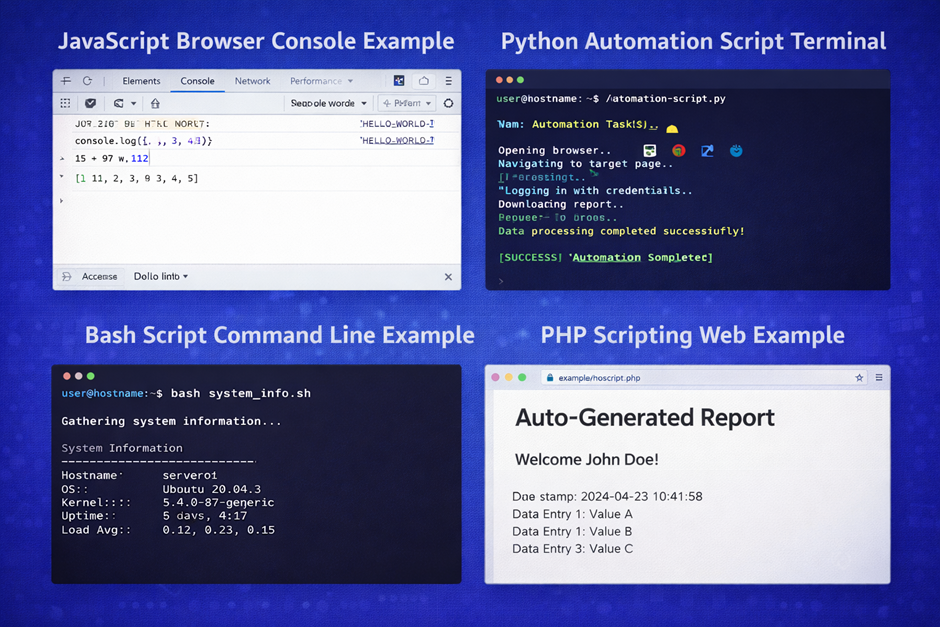
Scripting languages are designed for automation and rapid development. They are typically interpreted rather than compiled.
These languages are widely used for automating repetitive tasks, managing systems, and building lightweight applications.
They play a major role in system administration, web automation, and managing cloud environments.
Scripting languages are also used for processing files such as PDF documents and handling secure operations like password validation.
One of their biggest advantages is speed of development. Developers can quickly write and test scripts without complex compilation steps.
They are highly flexible and integrate well with other systems.
However, they may not offer the same performance as compiled languages.
Despite this, scripting languages are essential tools in modern development workflows.
Examples of Scripting Languages:
- JavaScript
- Python
- PHP
- Bash
- PowerShell
- Perl
- Lua
- Groovy
- Ruby
Logic Programming Languages
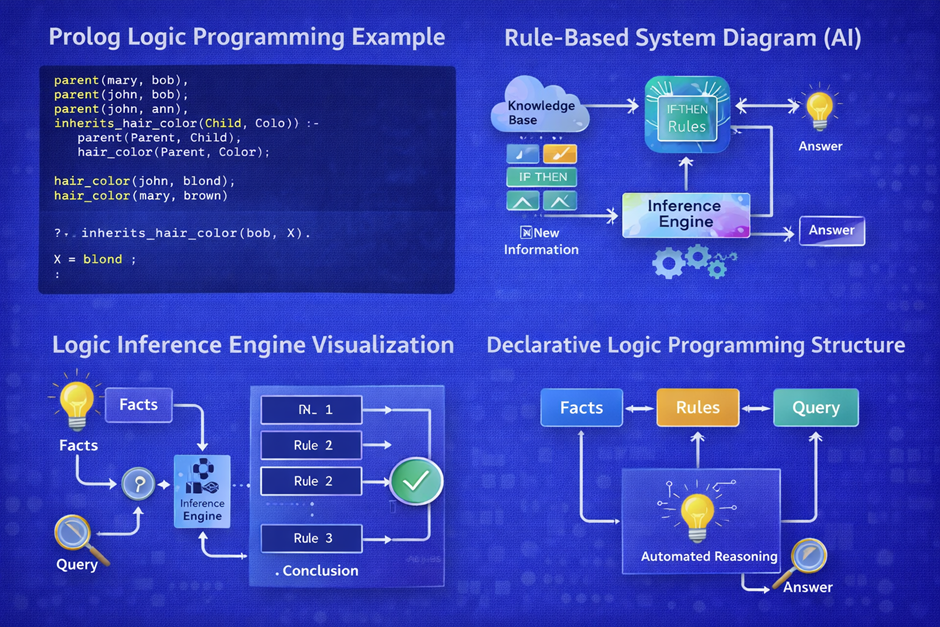
Logic programming is based on formal logic rather than explicit instructions.
Programs consist of facts and rules, and the system determines how to solve problems.
Prolog is a well-known example.
This paradigm is widely used in artificial intelligence and expert systems.
It allows developers to focus on defining relationships rather than writing step-by-step code.
However, it is not suitable for all applications.
It can be difficult to learn and requires a different way of thinking.
Despite this, it is powerful for solving complex logical problems.
Examples of Logic Programming Languages:
- Prolog
- Datalog
- Mercury
- CLIPS
- Answer Set Programming (ASP)
- Logtalk
Declarative Programming Languages
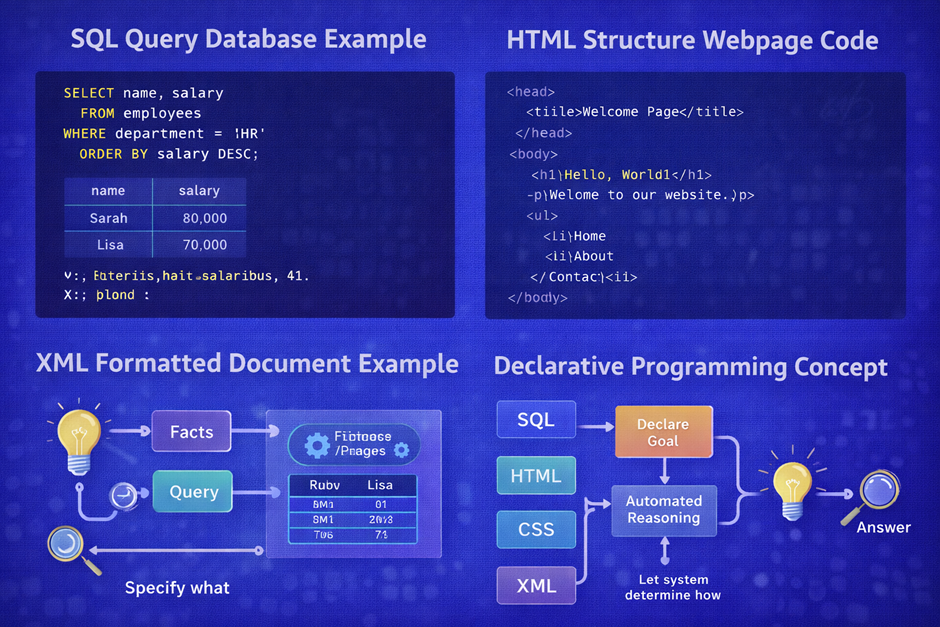
Declarative programming focuses on what a program should accomplish. It removes the need to define control flow explicitly. Languages like SQL are widely used in enterprise systems powered by companies such as Oracle. This paradigm simplifies code and improves readability. It is commonly used in databases, configuration systems, and web development. However, it offers less control over execution. Despite this limitation, it is extremely efficient for specific tasks.
Examples of Declarative Programming Languages:
- SQL
- HTML
- XML
- CSS
- XQuery
- GraphQL
Domain-Specific Languages (DSL)
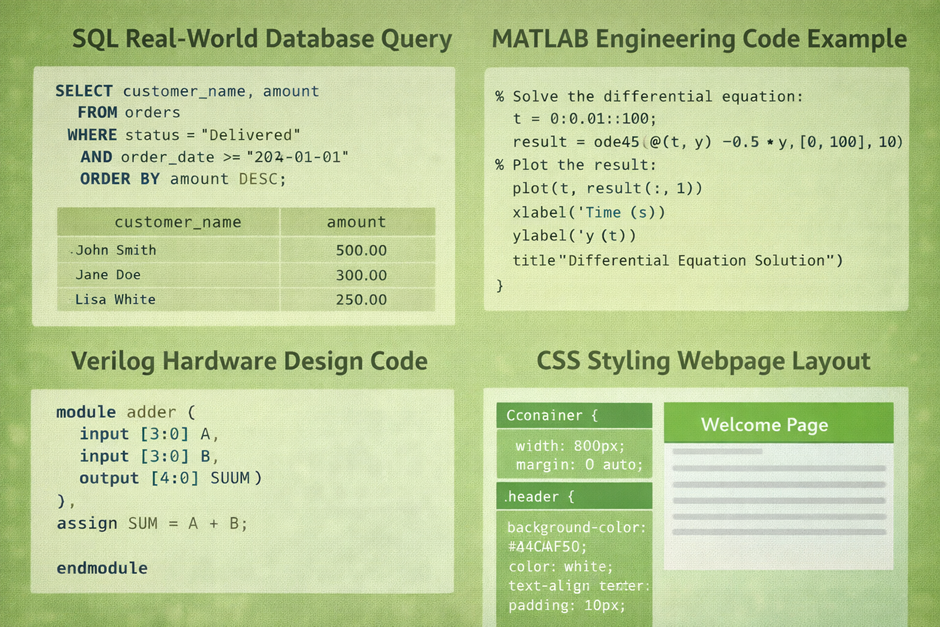
Domain-specific languages are specialized for particular tasks.
They are designed to solve problems within a specific domain efficiently.
Examples include SQL, MATLAB, and Verilog.
These languages are widely used in industries supported by companies like Intel, Samsung, Sony, Motorola, and HP.
They provide high efficiency within their domain but are limited in general-purpose use.
They are often used alongside general-purpose languages.
Examples of Domain-Specific Languages:
- SQL
- MATLAB
- Verilog
- VHDL
- CSS
- G-code
- R
Concurrent & Parallel Programming Languages
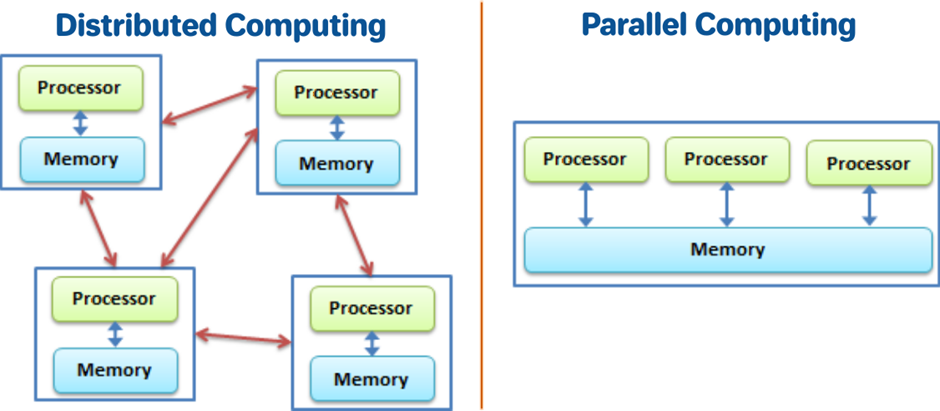
Parallel programming and concurrency enable multiple tasks to run simultaneously.
These approaches are essential for modern computing systems.
Languages like Go and Rust provide strong support for concurrency.
They are widely used in cloud computing and distributed systems.
These languages help maximize the performance of modern hardware.
However, concurrency introduces complexity such as synchronization issues.
Despite this, it is critical for building scalable applications.
Examples of Concurrent & Parallel Programming Languages:
- Go
- Rust
- Erlang
- Elixir
- Scala
- Ada
- Chapel
- Julia